Innovation Incubator
Medical Detectives | Product Improvement & Design Thinking
Project Overview
The Innovation Incubator is a scaffolded, project-based learning experience designed to introduce students to research, design thinking, and problem-solving in a supported, entry-level context. Developed in collaboration with PLTW coursework, the project centers the library as a shared instructional space. Students learn how to investigate problems, analyze existing solutions, and communicate their thinking.
Rather than assuming students already know how to navigate open-ended projects, the Innovation Incubator was intentionally designed with explicit instruction, structured choice, and clear checkpoints. Throughout the process, I modeled research strategies, guided students in making connections between ideas, and supported reflection so learning remained visible and manageable. This approach helped students build confidence while developing foundational skills they will continue to apply in future learning experiences.
The Innovation Incubator reflects my instructional approach in the library: thoughtful structure paired with meaningful choice, collaborative teaching, and a focus on helping students learn how to engage with complex tasks in ways that are accessible, equitable, and sustainable over time.
Purpose and Instructional Focus
The Innovation Incubator is a project-based learning experience designed to support PLTW coursework while making purposeful use of the Library & Innovation Center. It gives students structured time to work through real problems, think critically about how things work, and explore how ideas turn into solutions.
The focus of the Incubator is the process, not a single finished product. Students spend time identifying problems, asking questions, researching, revising ideas, and explaining their thinking. They are encouraged to slow down, try things out, make changes, and learn from what doesn’t work the first time.
This experience helps students build confidence as thinkers and problem-solvers. Instead of rushing toward an answer, they learn how to develop an idea, support it with evidence, and communicate it clearly. The Innovation Incubator creates space for curiosity, persistence, and meaningful learning that connects directly to classroom instruction.
How the Innovation Incubator Works
The Innovation Incubator is intentionally designed as a flexible instructional model that supports classroom learning while using the Library & Innovation Center as a space for thinking, research, and design. It is not a linear project with a single path. Students move through the work in stages, revisiting ideas and refining their thinking as they go.
Students begin by identifying a real-world problem and asking questions about how an existing product or system works. From there, they gather information, examine limitations, and think through possible improvements. The emphasis stays on understanding the problem before jumping to a solution.
Throughout the process, students are asked to explain their thinking, justify design choices, and reflect on what they are learning. Ideas are tested, revised, and sometimes reworked entirely. This structure allows students to experience innovation as an iterative process rather than a checklist of steps.
The Incubator gives students time and space to think deeply, make adjustments, and communicate their ideas clearly, while still staying closely connected to classroom instruction and learning goals.
My Role
My role in the Innovation Incubator is to design the structure that supports the work and step in at key moments to guide student thinking. I introduce the project, help establish shared language and expectations, and model how to move from an early idea to a clearly explained problem.
I work closely with students at natural checkpoints in the process. At the end of Phase 1, I help students pause and reflect on whether they can clearly explain the problem they are trying to address and who it affects. As Phase 2 begins, I support students as they shift from identifying problems to examining existing products and thinking about how those products could work better.
During Phase 2, I check in at a midpoint to help students refine their ideas, strengthen their explanations, and slow down when needed. This is also where I support responsible use of tools like NotebookLM, helping students use AI to check clarity and design decisions rather than generate answers for them.
At the end of Phase 2, I coordinate the product pitch experience and help prepare students to share their thinking with an authentic audience. Throughout the process, my goal is to provide structure and feedback without taking ownership away from students, so they build confidence in their ideas and their ability to communicate them.
Phase 3: Communicating Ideas Through Design & Marketing
In Phase 3, students shift from improving a product to communicating their thinking to an audience. Building on the work from the Innovation Incubator, classes focus on how ideas are presented, explained, and shared through basic marketing and design principles.
Students learn that strong solutions need clear messaging. They consider audience, purpose, and clarity as they design logos, visuals, and short pitches connected to their product improvements. As part of this work, students also practice media literacy by thinking about how images, language, and format influence understanding and interpretation.
The makerspace supports this phase as a tool for communication. Students may choose to create items such as buttons, printed materials, simple merchandise, or digital models using tools like the button maker, DTF printer, Cricut, or 3D printer. These choices are optional and intentional, based on how well a tool supports the message they want to convey.
Phase 3 reinforces that innovation doesn’t end with a good idea. It also involves explaining that idea clearly, adapting it for an audience, and making thoughtful design choices that support understanding.
Makerspace Connection: Design, Redesign & Innovation
The makerspace supports the Innovation Incubator, but it is not the starting point and it is not required for every project. While some students choose to create physical or digital models as part of their work, the focus remains on thinking, design, and communication rather than fabrication.
Students may use makerspace tools to prototype ideas, test concepts, or visualize design improvements when it makes sense for their project. This might include simple materials, digital modeling, or design software, depending on the needs of the group. The choice to build is intentional, not automatic.
By separating design thinking from making, students learn that innovation is not defined by how complex a build looks. Strong ideas can exist on paper, in a sketch, or in a digital rendering. The makerspace is one option for exploring ideas more deeply, not a requirement that limits access or success.
Phase 4: Extensions & Real-World Connections
Phase 4 offers students an opportunity to look beyond the classroom and explore how innovation and design work in the real world. This phase is intentionally optional and ungraded, giving curious students space to extend their thinking without adding pressure or expectations.
After completing the core project, students may independently explore examples of designers and makers who work with real people and real needs. One resource introduced at this stage is Makers Making Change, which highlights assistive and adaptive product design grounded in human-centered problem solving.
This exploration is framed as observation and inspiration, not problem-solving. Students are not expected to design solutions or take on complex challenges. Instead, the focus is on noticing how professionals identify needs, iterate on existing products, and consider impact, access, and usability in their work.
Phase 4 reinforces that the skills practiced during the Innovation Incubator—questioning, evidence-based reasoning, design thinking, and reflection—extend beyond a single project and connect to meaningful work in the world.
Collaboration & Partnerships
The Innovation Incubator is built in collaboration with classroom teachers, particularly PLTW courses, and is designed to fit naturally within existing instruction. Planning happens together, with shared expectations around pacing, student support, and outcomes. The goal is alignment, not add-on work.
Throughout the process, I stay in close communication with teachers to support instruction, troubleshoot challenges, and adjust as needed. This includes coordinating timelines, supporting research and design tools, and helping ensure students have what they need to move forward.
The Incubator also creates opportunities for broader connection within the building. When student work is ready, administrators and instructional leaders may be invited to see student pitches and provide feedback. These moments help reinforce that student thinking and communication matter and give students experience sharing their ideas with an audience beyond the classroom.
Using AI to Support Learning
In the Innovation Incubator, I introduced students to NotebookLM as a research and sense-making tool. By curating sources ahead of time, I guided students through listening to AI-generated audio overviews, then slowing down to evaluate claims, locate supporting evidence, and identify design problems worth solving.
AI was positioned as a tool for organizing information, not doing the thinking. Student work focused on reflection, evidence checking, and collaboration, with clear expectations that ideas and decisions came from students. This approach supported digital citizenship and inquiry-based learning without replacing productive struggle.
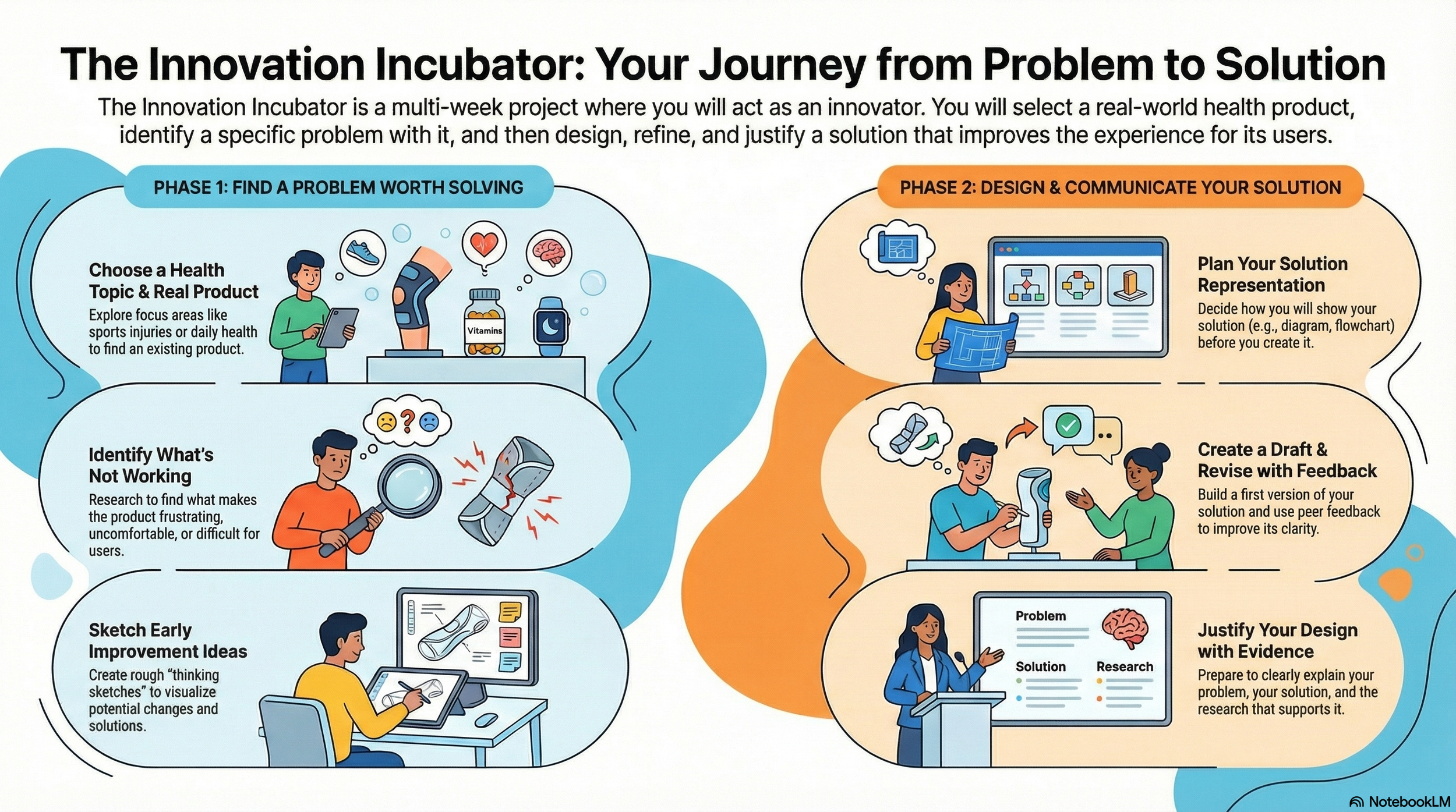
I also used NotebookLM to create a student-friendly infographic explaining the goals and process of the Innovation Incubator. Providing this visual overview upfront helped students quickly understand expectations so class time could focus on collaboration, problem-solving, and design thinking rather than repeated clarification.
Artifacts & Student Work

Because the Innovation Incubator is in the early stages of implementation, current artifacts focus on instructional planning and teacher-facing materials. These include project overviews, slide decks, timelines, and support resources designed to help launch the work with clarity and consistency.
As the project progresses, student work samples and reflections will be added to show how ideas evolve across phases and how students communicate their thinking through pitches, designs, and revisions. This section will continue to grow as the Innovation Incubator moves from planning into full implementation.
For a more detailed look at the project design and instructional materials, see the Innovation Incubator project overview (PDF).
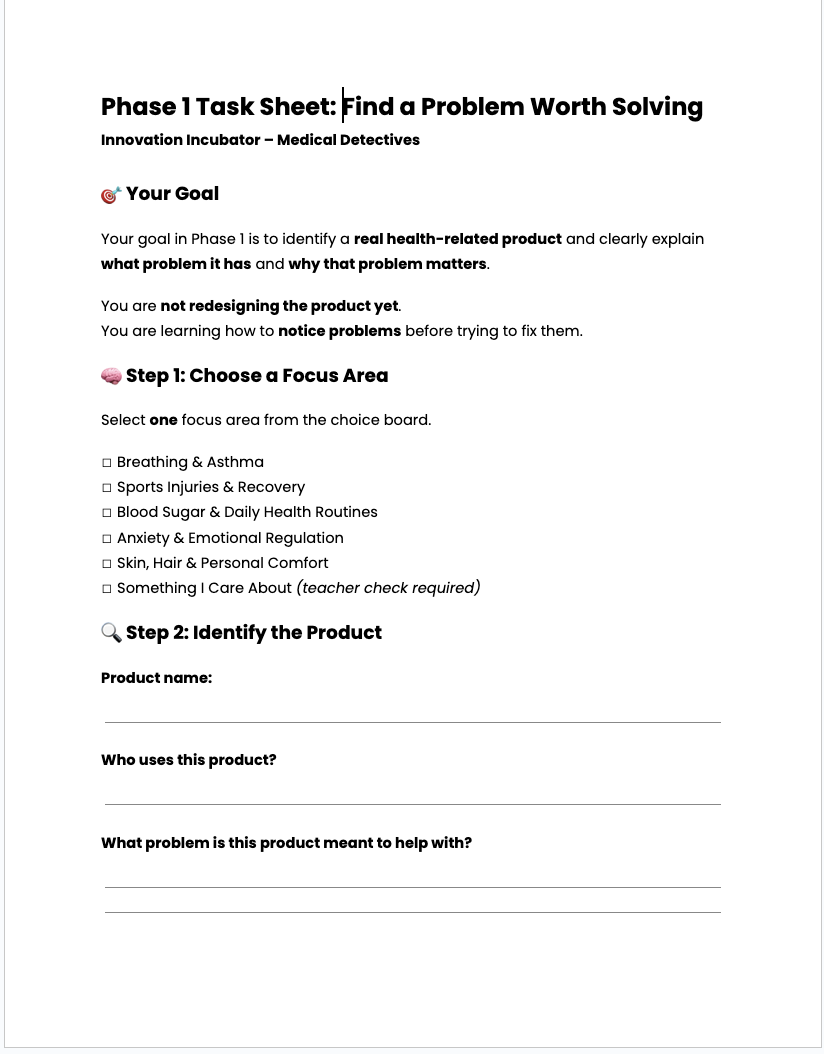
Selected instructional artifacts from the Innovation Incubator are shown below.